
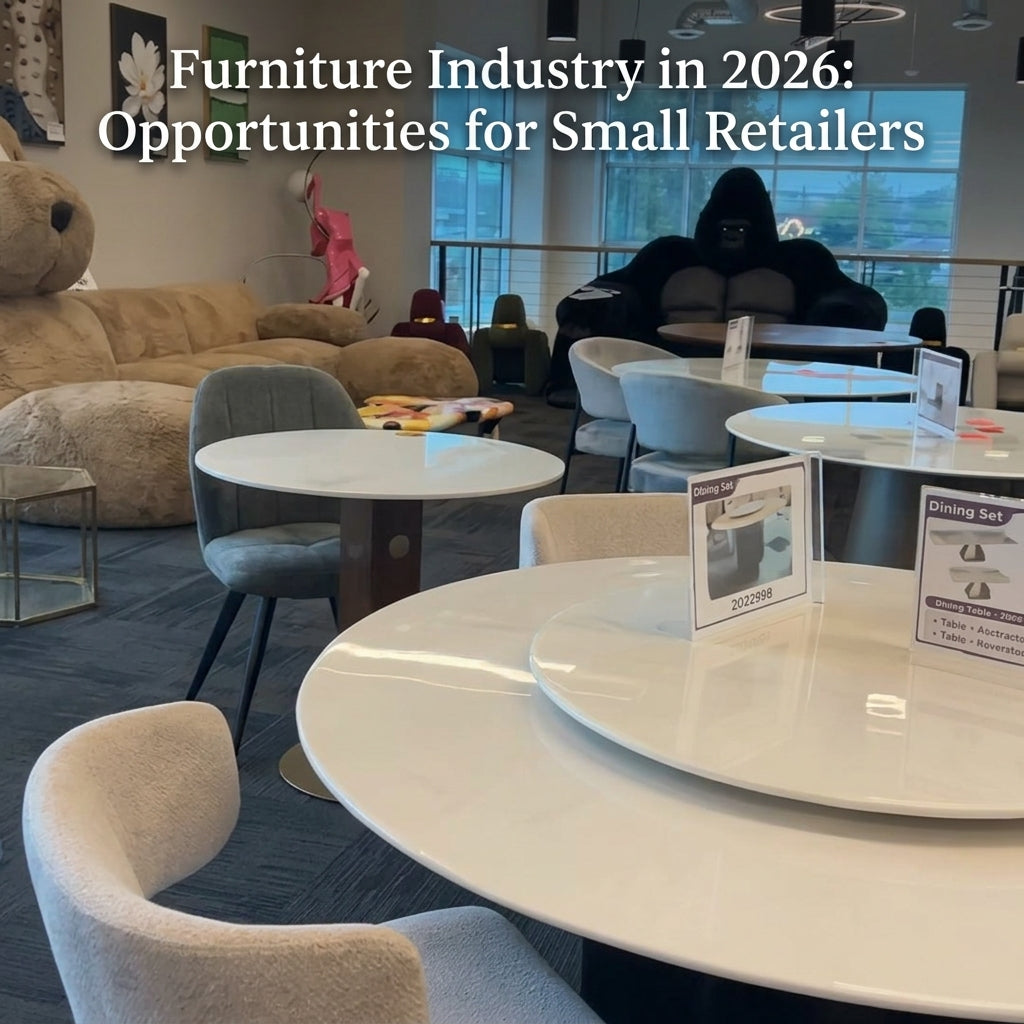
The U.S. furniture market is changing, but that does not mean opportunities have disappeared. For small furniture retailers, 2026 is a year to pay closer attention to customer needs, inventory costs, product selection, and supplier reliability.
Consumers are still investing in their homes, but many are becoming more selective about what they buy. Retailers who understand their local markets, offer products that fit their customers' budgets, and manage inventory carefully may be better positioned to compete.
So, is the furniture industry still worth entering in 2026? The answer depends less on market growth alone and more on how retailers build and manage their businesses.
1. What Does the U.S. Furniture Market Look Like in 2026?
Recent industry data points to a market with both challenges and opportunities.
According to the U.S. Census Bureau's retail sales data, advance estimates put U.S. furniture and home furnishings store sales at approximately $10.7 billion in September 2026, seasonally adjusted. This measures retail sales at furniture and home furnishings stores, rather than the entire furniture supply chain.
Meanwhile, Circana's September 2026 home industry forecast projects that U.S. home-industry dollar sales will reach $43.7 billion in 2026, up 2.9% from 2025. Circana also notes that demand for units remains under pressure, with replacement purchases, higher average selling prices, and changing consumer routines influencing the market.
These figures measure different parts of the market, so they should not be treated as interchangeable. Together, however, they suggest that the home market is not simply disappearing. Instead, consumers are making more deliberate purchasing decisions.
For small furniture retailers, the key question is not just whether the market is growing. It is which products customers still want, what they are willing to pay for, and how retailers can meet those needs without taking on unnecessary financial risk.
2. Five Opportunities for Small Furniture Retailers in 2026
Opportunity 1: Focus on Practical Home Upgrades
Not every customer is planning a major home renovation or purchasing an entirely new furniture set. Some are replacing an old sofa, upgrading a bedroom, adding storage, or making a small room more functional.
These smaller, purpose-driven purchases can create opportunities for retailers who understand their customers' everyday needs.
Consider offering products that solve specific problems, such as:
-
Storage-friendly bedroom furniture for smaller homes.
-
TV stands that combine storage with features such as an electric fireplace.
-
Comfortable accent chairs that add seating without requiring a complete room redesign.
-
Vanity desks that combine lighting, storage, and a dedicated beauty space.
-
Multifunctional furniture that makes better use of limited floor space.
The goal is not to stock every possible product category. It is to identify the needs that matter most to your local customers and build a focused selection around them.
Opportunity 2: Differentiate Through Product Features and Design
Competing only on price is difficult, particularly for small retailers that cannot always match the purchasing power of large chains.
A more sustainable approach is to offer products with clear reasons for customers to choose them.
For example, a retailer might differentiate a bedroom furniture selection through storage capacity, integrated lighting, distinctive finishes, or space-saving designs. In a living room collection, the difference might be a unique sofa shape, practical storage, or a feature that makes a product more versatile.
Before adding a new item, ask three questions:
-
What makes this product different from similar options in the market?
-
Which customer would be most likely to buy it?
-
Can the product deliver enough value to justify its selling price?
A product does not need to be completely unique to stand out. Sometimes, the right combination of design, functionality, price, and local availability is enough to make it attractive.

Opportunity 3: Build a Balanced Product Mix
A broad catalog may look impressive, but it can also tie up cash in products that sell slowly.
Small retailers can reduce this risk by building a balanced product mix rather than purchasing heavily in one category.
One practical approach is to organize products into three groups:
Core products: Familiar furniture styles that meet regular customer needs and are suitable for ongoing replenishment.
Differentiated products: Items with distinctive designs, useful features, or stronger visual appeal that help the store stand out. For example, TV stands with fireplaces can combine media storage with an electric fireplace feature, giving customers a practical alternative to standard TV stands.
Test products: New styles or emerging trends that are introduced in limited quantities before the retailer commits to larger orders.
This approach allows retailers to maintain a reliable core selection while testing new opportunities.
Review sales performance regularly. Track how quickly products sell, how much margin they generate, and whether customers are asking for repeat purchases. A product that attracts attention but remains unsold for months may not be as valuable as a less exciting item that turns over consistently.
Opportunity 4: Use Online Content to Support Local Sales
A physical furniture store does not need to become a large e-commerce operation to benefit from online marketing.
Customers often research furniture before visiting a store. Clear product photos, short demonstration videos, accurate dimensions, and transparent pricing can help shoppers decide whether an item fits their needs.
Small retailers can start with a few straightforward activities:
-
Post short videos showing product features and dimensions.
-
Share new arrivals and available inventory on social media.
-
Keep business hours, contact information, and store photos up to date on Google.
-
Create simple product pages or catalogs that customers can browse before visiting.
-
Encourage satisfied customers to leave honest reviews.
Content should answer real purchasing questions. For example, show how much storage a dresser provides, how a sofa looks in a real room, or how a TV stand's fireplace function works.
You do not need a large marketing budget to begin. Consistent, useful content can help customers discover your store and feel more confident before making a purchase.

Opportunity 5: Choose Suppliers That Help Control Inventory Risk
Product selection matters, but the supplier behind each product matters just as much.
For a small furniture retailer, a supplier with attractive prices may not be the best option if inventory is unreliable, replenishment takes too long, or communication becomes difficult when a problem arises.
When evaluating a furniture wholesaler, consider:
-
Inventory availability: Can the supplier tell you what is in stock and how availability changes?
-
Replenishment: Can you reorder products that sell well without excessive delays?
-
Order flexibility: Can you test demand before committing to large quantities?
-
Delivery options: Are local pickup, warehouse pickup, or freight arrangements available?
-
Product information: Are dimensions, specifications, images, and other sales materials easy to obtain?
-
Communication: Can you get timely answers about orders, stock, and delivery?
These factors affect more than convenience. They influence how much inventory you need to hold, how quickly you can respond to customer demand, and how much cash remains available for other business expenses.
A reliable supplier relationship can help a small retailer operate more confidently, particularly when demand is difficult to predict.
3. What Small Furniture Retailers Should Avoid
Opportunities exist, but entering the market without a clear plan can create unnecessary risk.
Avoid buying too much inventory too early
A large showroom or warehouse is not automatically a successful business. Unsold inventory consumes cash, takes up space, and may eventually require discounts to move.
Start with a manageable selection, monitor actual sales, and expand based on evidence rather than assumptions.
Avoid competing on price alone
Lower prices can attract customers, but price competition may leave little room for operating expenses, delivery costs, returns, and marketing.
Instead, communicate why your products are worth buying. Useful features, clear product information, convenient service, and dependable availability can all contribute to a stronger customer proposition.
Avoid chasing every trend
A product that performs well on social media may not suit your local customer base or price range.
Test unfamiliar styles in smaller quantities when possible. Use customer inquiries and actual sales results to decide whether a trend deserves a larger investment.
Avoid choosing suppliers based only on the lowest price
A lower wholesale price may not translate into a lower total business cost if products arrive late, stock information is inaccurate, or replacement inventory is difficult to obtain.
Evaluate the full purchasing process, including delivery, product quality, communication, and replenishment.
Avoid confusing revenue with profit
Strong sales do not necessarily mean a healthy business. Retailers should understand gross margin, inventory turnover, delivery expenses, advertising costs, and the cash tied up in stock.
Before expanding, make sure the business can support the additional inventory and operating costs.
4. How to Start a Furniture Retail Business With Less Risk
For new retailers and established stores entering a new product category, a measured approach is often more practical than expanding quickly.
Step 1: Define your target customer.
Decide whether you primarily serve budget-conscious households, first-time homeowners, renters, families, or customers looking for distinctive furniture designs. A clear customer profile helps narrow your product selection.
Step 2: Research your local market.
Visit competing stores, review local customer feedback, and identify gaps in product selection, service, or price. Look for unmet needs rather than assuming that popular products will sell everywhere.
Step 3: Build a focused catalog.
Choose a manageable range of products that covers your customers' main needs. Prioritize items with clear selling points and suitable price positioning.
Step 4: Test demand before scaling.
Where supplier terms allow, start with smaller orders or limited quantities. Measure sales and customer response before investing more heavily.
Step 5: Establish a reliable supply process.
Confirm inventory, lead times, delivery arrangements, and reorder procedures before depending on a supplier for your core products.
Step 6: Review results regularly.
Use actual sales and margin data to decide what to reorder, what to promote, and what to discontinue. Let performance guide expansion.
This process will not eliminate business risk, but it can help retailers make better-informed decisions and avoid tying up too much capital in unproven products.
5. Why Local Furniture Supply Can Matter
For small furniture retailers, access to available inventory can be an important part of supplier selection.
Working with a U.S.-based furniture wholesaler may provide practical advantages, depending on the supplier's inventory, location, and delivery options. These can include the ability to inspect selected products, arrange warehouse pickup, or coordinate domestic freight rather than relying exclusively on long-distance international shipping.
Local availability does not guarantee that every product will be in stock or that every order will arrive immediately. Retailers should still confirm current inventory and delivery arrangements before placing orders.
For stores that want to expand their selection without managing every part of the supply chain themselves, a wholesale partner with clear product information and responsive support can make day-to-day purchasing easier.
At VANITII, we work with furniture retailers looking for home furniture across categories including bedroom furniture, vanity desks, sofas, TV stands, and accent furniture. Our wholesale program is designed to help retailers explore products and wholesale purchasing options for their businesses.
Retailers interested in our product range and wholesale account options can visit the VANITII Wholesale Program to learn more.
6. Is the Furniture Industry Still Worth Entering in 2026?
The furniture industry still offers opportunities, but success is not guaranteed by market growth alone.
The most promising approach for a small retailer is to understand a specific customer group, select products with clear value, manage inventory carefully, and build relationships with suppliers that support the business over time.
Rather than trying to carry everything or compete with the largest retailers on price, focus on doing a few things well: offering the right products, serving customers reliably, and making purchasing decisions based on real results.
The opportunity in 2026 is not simply to sell more furniture. It is to build a more focused, flexible, and financially disciplined furniture business.
For small retailers willing to learn from their customers and adapt their product selection, there is still room to build a business that meets real needs in the home furniture market.


Leave a comment
This site is protected by hCaptcha and the hCaptcha Privacy Policy and Terms of Service apply.