
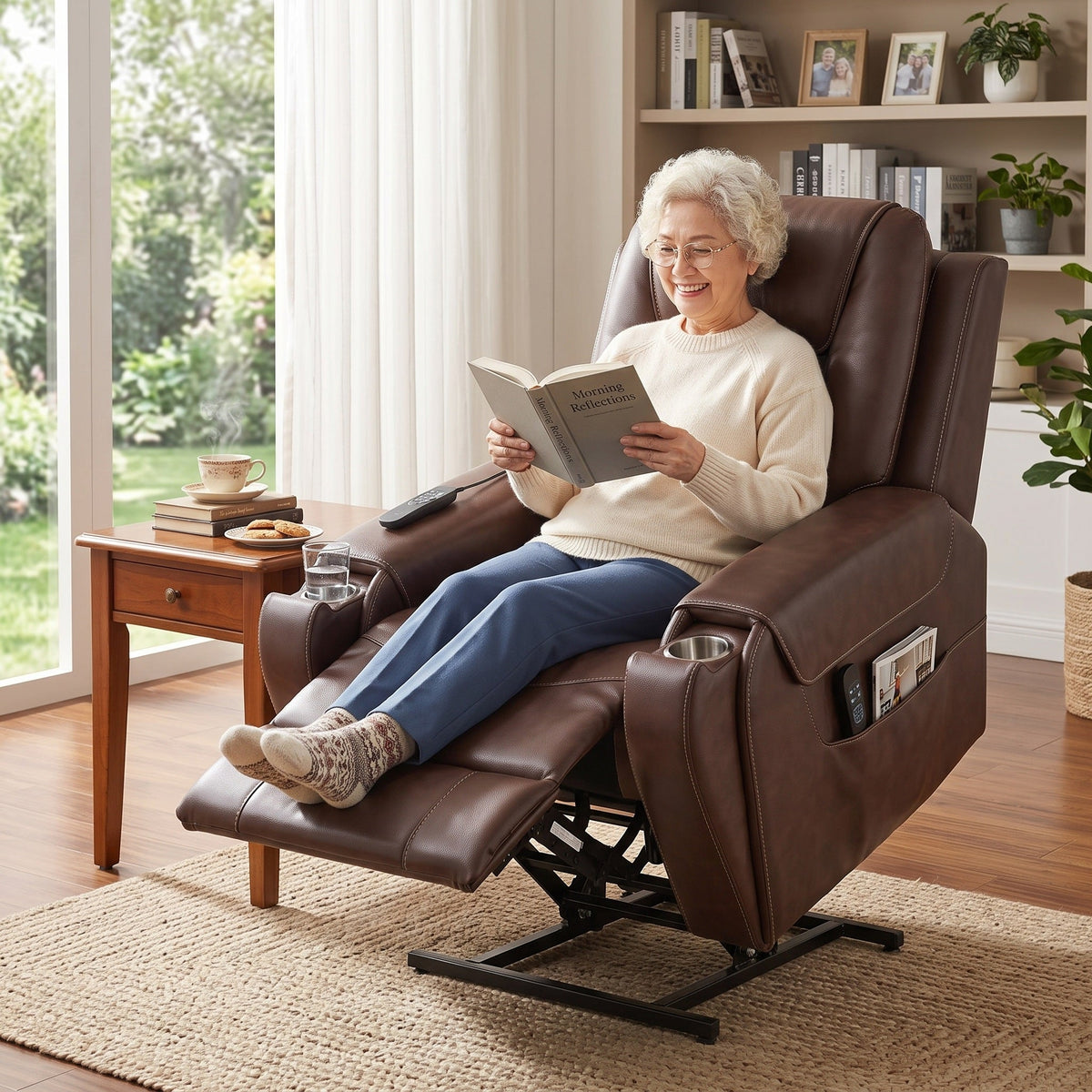
What worries you most when visiting your parents?
Many would say health issues or chronic illnesses. But what truly makes your heart clench are often small moments—your mother instinctively supporting her back as she gets up from the sofa, or your father needing several seconds to steady himself after sitting for a while.
These moments are so brief, so fleeting, that the elderly themselves often don't even notice them. But it is precisely these seemingly insignificant "struggles" that wear down their joints and lumbar spine day after day, quietly eroding their confidence in living independently.
If you are looking for a suitable power lift recliner for elderly family members, this guide aims to help you clarify your thoughts—not by piling on specifications, but by discussing the key points that truly affect their daily experience.
The Assisted Lift: The Most Effective Part of the Chair
According to the CDC's fall prevention guidelines, reducing daily physical strain and creating accessible seating are critical steps in helping seniors maintain independence and prevent home injuries.
The core value of an electric reclining chair is to help the elderly stand up easily. But "being able to rise" and "rising comfortably" are two different things.
Some products on the market prioritize high motor power and fast lifting speed, believing this demonstrates strength. However, what's truly suitable for elders is a slow and smooth movement—slow enough for the body to keep pace with the chair's rhythm, and slow enough that there's no abruptness when shifting weight.
Another detail worth noting: a good lifting trajectory involves simultaneous forward and upward movement. Because the natural movement of getting up involves shifting the center of gravity forward, if the movement is only upward without forward, the body will be pushed backward by the chair, making it more difficult to stand up. Try sitting in it and you'll see—you won't be "pushed" up, but rather steadily "supported," with no strain on the knees and no need to tense the back.
- Advice for children: When helping elders try sitting in a chair, don't just focus on whether they can stand up; pay attention to whether the process is natural and smooth. If the elder says "it's quite smooth" after trying it, then it's good.
- Advice for elders: Don't think of it as something "only for the elderly." It's simply there to lend a hand when needed, allowing you to continue doing what you can.
Looking for a reliable lift chair? Explore our VANITII Power Lift Recliner Collection engineered with dual-motor stability and premium leatherette finish.
Comfortable Sitting Makes People Want to Stay Longer
While a chair that helps you stand up addresses the issue of getting up, older adults spend most of their time sitting.
Lumbar support is a blind spot that many people easily overlook. The backrests of most ordinary chairs are flat, causing the lumbar spine to naturally sag after sitting for a long time, which actually increases the burden on the lower back. A good chair that helps you stand up should provide a gentle, supportive curve along the natural curve of the lumbar spine—neither deliberately pushing against the lower back nor leaving it unsupported, allowing the spine to maintain its natural physiological curve while seated.
As for the reclining angle, we've always believed it shouldn't be limited. Reading, watching TV, chatting with family, afternoon naps—each scenario requires a different angle. A stepless adjustment design allows you to stop at any comfortable position, rather than compromising between fixed settings.
- Advice for children: Pay attention to what your elders do most often at home—do they watch TV for long periods or frequently nap? This will determine your priority for the reclining range and lumbar support needs.
- Advice for elders: When trying out the chair, try different positions to see what's most comfortable. This chair is for you, not for you to adapt to it.
A Spacious Seating Area is the Foundation of Comfort
The width, depth, and height of the seat cushion directly affect whether elders are willing to sit in it.
If the seat cushion is too deep, shorter elders won't be able to lean against the backrest, and their feet will dangle and not reach the ground, making them feel "nested" inside. If the seat cushion is too shallow, the thighs won't get enough support, leading to fatigue after prolonged sitting. The ideal seating experience is: feet firmly planted on the ground, back naturally resting against the backrest, and thighs fully supported but not compressed.
The filling material is also worth considering. High-density, high-resilience foam is more durable than ordinary foam, providing a snug fit without collapsing to the bottom—that kind of "sink to the bottom" softness actually makes getting up more difficult.
- Advice for children: Measure the seat height and depth of the chair your elders usually sit in as a preliminary reference. But ultimately, let your elders sit in it themselves to experience the comfort.
- Advice for elders: After sitting down, try moving left and right to see if you feel cramped. Spaciousness doesn't mean large; comfort is key.

![]() Easy-to-C
Easy-to-C![]() are-for Fabrics Ensure Peace of Mind
are-for Fabrics Ensure Peace of Mind
Elders' furniture usage habits differ from younger people's. Placing water cups on armrests, leaning directly against them when sweating, and occasionally spilling soup are all common occurrences.
Given this, high-quality faux leather is a more practical choice than fabric. Liquid splashes won't seep in, dust can be wiped away easily, it doesn't require regular washing, and it doesn't harbor bacteria like fabric. However, the key is a good feel—good faux leather is matte, supple, doesn't stick to the skin in summer, and isn't cold to the touch in winter; it has a warm, textured feel.
- Advice for children: If elders spend long periods in bed or sweat easily, prioritize breathable faux leather fabrics, making daily cleaning much easier.
- Advice for elders: Don't worry about faux leather being "unattractive." Good faux leather nowadays has a warm, smooth texture and color, avoiding a cheap or cold look.
Storage Isn't a Gimmick; It Reduces Bending Over
Young people's home aesthetics often prioritize minimalism, believing that everything looks best when stored away in cabinets. However, the older generation operates on a different logic—they want things within easy reach.
Side storage bags and armrest storage compartments may seem insignificant, but they are used daily. Remote controls, reading glasses, throat lozenges, blood pressure monitors—keeping these small items within easy reach means the older generation can bend over less often and avoid the risk of losing their balance.
The same principle applies to cup holders on both sides. A cup of warm water can be placed securely without tipping over, making drinking water much easier.
- Advice for children: Observe what items your elders need to reach in the living room daily. This will help you assess the adequacy of your storage design.
- Advice for elders: Sit down and simulate reaching for the remote control or placing a water cup to see if it's convenient.

It Should Blend into the Living Room, Not Be Hidden Away
This is the most perplexing point for many families when choosing a chair.
A well-designed reclining chair often looks like medical equipment—dark, heavy, and square—and clashes with the home. Elders themselves may also feel pressured, as if sitting in it is an admission of "I'm getting old."
But good design can change this impression. Soft contours, color schemes similar to home upholstered sofas, neat stitching, and full cushions—a chair placed in the living room looks like a decent lounge chair, just with a built-in reclining function. It shouldn't be tucked into a corner, but rather become a piece of furniture that people want to sit on.
More Than Just a Chair: Creating a Truly Comfortable Corner for Elders
At this point, let's broaden our perspective.
A good reclining chair solves the core issues of "sitting" and "standing up." But the experience of elders in the living room goes far beyond a chair—the temperature, the lighting, the sound clarity—all directly impact their mood and comfort in that space each day.
In autumn and winter, many elders huddle on the sofa to stay warm, slowing blood circulation and making their joints more prone to stiffness. When watching TV or listening to opera, they worry about disturbing family members with the volume too high, or not being able to hear clearly with it too low, constantly adjusting the volume—a hassle they find inconvenient.
These seemingly unrelated details are actually the final piece of the puzzle for "living room comfort."
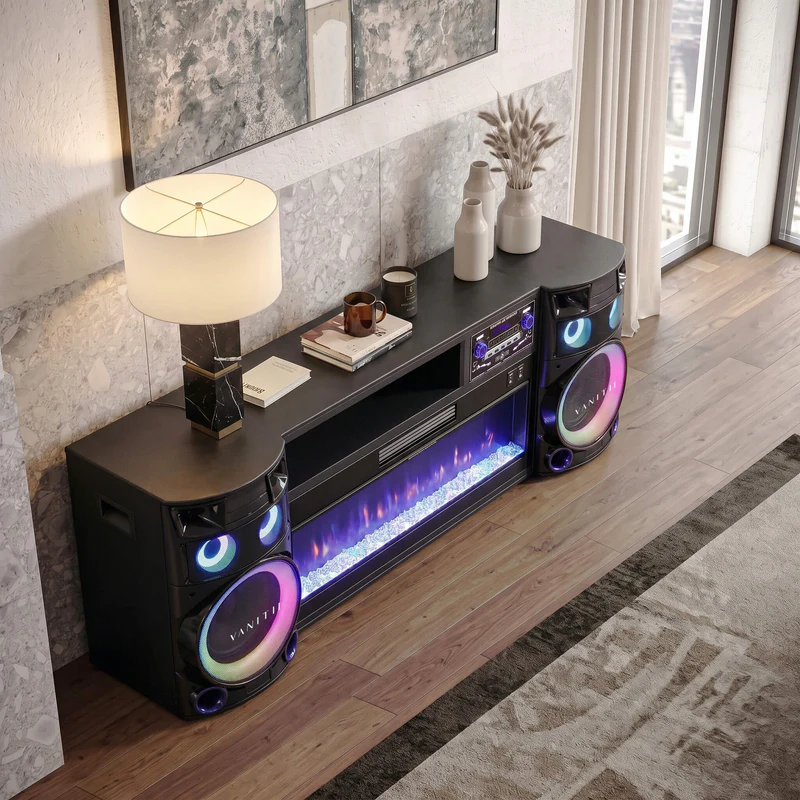
If you're creating a truly thoughtful relaxation area for your elders, consider our newly launched smart fireplace and speaker combo. It combines two things in one:
- A simulated electric fireplace: Visually creating a warm flame effect, it doesn't get hot or scalding, but the warm light instantly warms the entire corner. Many elders have reported that seeing the "firelight" makes the space feel less cold, and they're more willing to sit in their chairs a little longer.
- Bluetooth speaker system: After connecting to a phone or TV, the sound comes directly from the fireplace, clear but not harsh. Seniors can watch the news, NBA, listen to music, or listen to the radio without having to turn the TV volume up so the whole family can hear.
These two products together don't just create a simple "1+1=2," but rather "1+1>2"—the reclining chair provides support and freedom, while the fireplace and speaker system creates a warm and comfortable atmosphere. One cares for the body, the other for the mind, together forming a safe and inviting corner that seniors truly want to be in.
On the right is this chair, on the left is the warm light from the fireplace, tea at hand, and music playing in the background—this is probably the best everyday life we can give our elders.
Ultimately, it's a gift about "autonomy." Many children who come to choose a chair for their parents ask not about price or features, but rather: "Will my parents be willing to use it?"
The subtext behind this question is—they care about their elders' feelings and don't want anything to remind them that "you're getting old."
Therefore, we firmly believe that a good reclining chair is more than just helping people stand up. It's a tool that allows seniors to continue performing daily activities independently, a source of confidence they can do without asking for help, and a beautiful chair in the living room that makes you want to sit down.
The right chair is more than just helping them stand up. It allows them to continue living comfortably and at ease.
Further Reading: If you'd like to learn more about creating a warm and immersive soundscape for your seniors in their living room, please check out our other detailed guide:

Leave a comment
This site is protected by hCaptcha and the hCaptcha Privacy Policy and Terms of Service apply.