
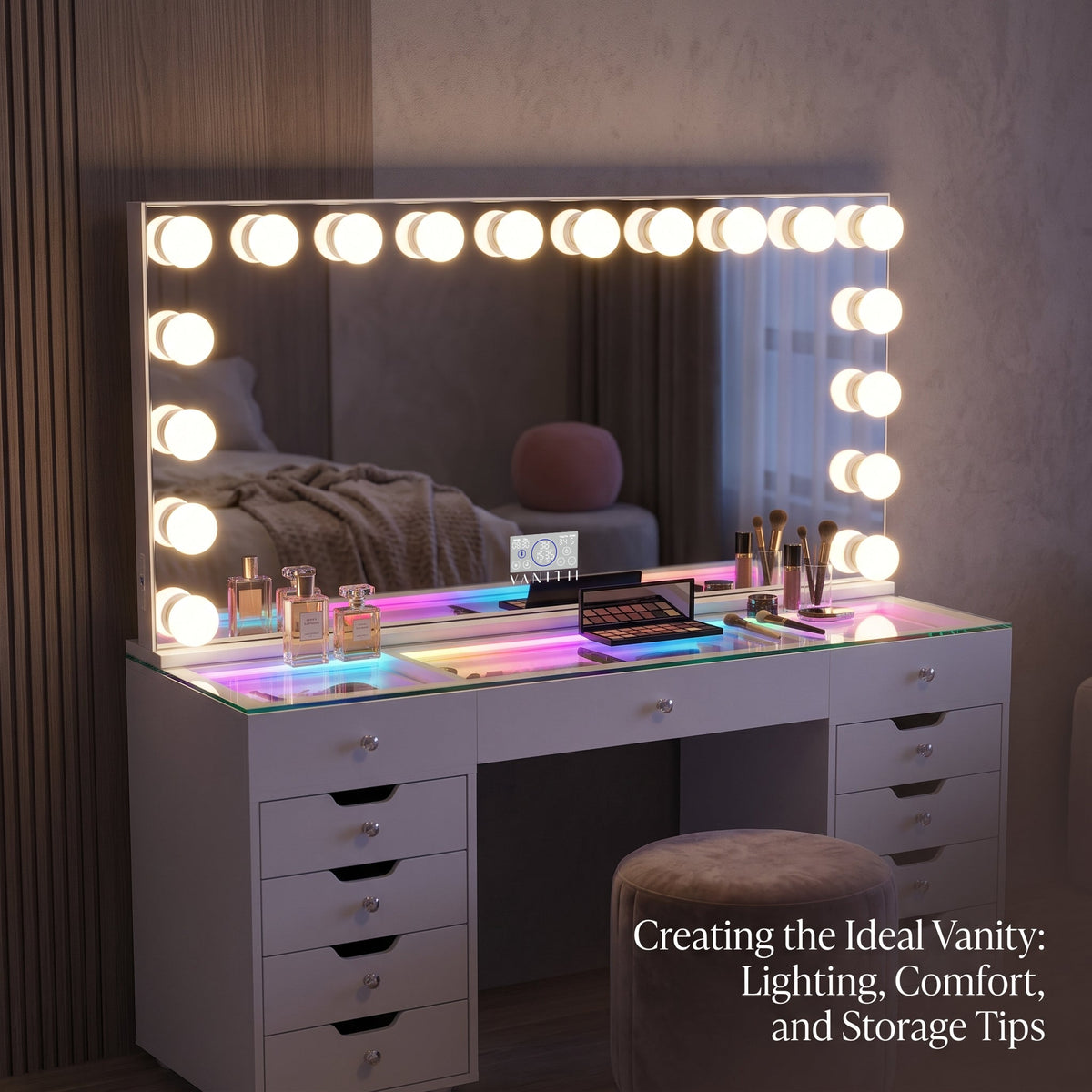
A vanity is one of the most practical pieces of furniture in the bedroom—provided it actually meets the user’s daily needs.
In our conversations with furniture retailers, interior stylists, and end-users, we’ve noticed a recurring pattern: many people are drawn to a vanity’s appearance but start regretting the purchase after just a week. The issue is rarely poor quality; rather, it stems from inadequate lighting, awkward seating ergonomics, or inconvenient storage.
If you are selecting or shopping for a vanity, try looking beyond the aesthetics. A truly functional vanity layout balances three key elements: excellent lighting, comfortable proportions, and practical storage.

Focus on the lighting around the mirror, not the mirror itself
If you ask end-users what the most important part of a vanity is, most will say the mirror. However, what truly determines whether they’ll want to sit down at it every day is the lighting surrounding that mirror.
Standard overhead bedroom lighting casts shadows in the eye sockets, under the nose, and beneath the chin. Unable to see details clearly while applying makeup, users instinctively lean forward or squint; over time, they conclude that the vanity is simply “not good to use.” For retailers, this is an easily overlooked source of negative reviews; for individual buyers, it is the single most important detail to verify before purchasing.
This explains the enduring popularity of Hollywood-style vanity mirrors. Instead of relying on a single light source, they feature multiple bulbs arranged around the mirror to illuminate the face from various angles. The goal isn’t to brighten the room, but to make the face clearly visible.
Dimmable lighting is a genuine need, not just a gimmick
Brightness is only one aspect of lighting; the color and intensity of the light directly affect how makeup and skin tone appear.
Feedback indicates that fixed-brightness vanity lights are a frequent source of complaints. Users often find the light too harsh when removing makeup at night, yet insufficient when applying it in the morning. Dimmable lighting has become a standard feature on mid-to-high-end vanities—not merely for the sake of luxury, but because different situations require different lighting conditions.
For retailers, this offers a great opportunity for a live demonstration: letting a customer adjust the lighting themselves is far more effective than simply telling them, “Our lights are excellent.”
View the mirror, tabletop, and chair as a single system
The mirror should not be considered in isolation from the vanity table beneath it.
If the mirror is too low, the user will unconsciously hunch forward; if the tabletop is too high, the shoulders will shrug up; if the chair is too low, the user has to tilt their head down. These issues aren’t apparent in product photos, but they become obvious after just a week of use.
During product testing, we discovered that many vanity mirrors are designed based on “visual proportions” rather than “seated sightlines.” Consequently, when users sit down, their line of sight falls too low, forcing them to adjust their posture awkwardly to accommodate the table.
That’s why we position the center of the mirror about 50–55 cm above the tabletop, allowing users of most heights to look straight ahead while sitting upright. While this detail might not be highlighted in marketing copy, it directly influences repeat purchases and word-of-mouth recommendations.
If you are comparing different designs, understanding standard vanity dimensions is very helpful.
The tabletop is a workspace, not a display area
A vanity is essentially a compact personal workspace.
When applying eyeliner, grooming eyebrows, or using skincare products, users need sufficient space to rest their elbows and forearms. However, many vanities have large tabletops that are cluttered with storage boxes and bottles right in front of the mirror, leaving an actual usable depth of less than 20 cm.
We’ve spoken with several retail clients who report that when customers test vanities in-store, their primary concern isn’t aesthetics, but whether there is room for their elbows. If they can’t find a comfortable posture within those first 30 seconds, they won’t buy.
When advising retailers on product displays, we emphasize one key point: avoid cluttering the tabletop. Leave at least 30 cm of clear space directly in front of the mirror so customers can immediately sense that there is room to apply makeup—like eyeliner—comfortably. This detail directly impacts sales conversion rates.
The same principle applies to individual buyers: keep only daily essentials on the tabletop and store everything else in drawers. This creates a functional workspace and makes cleaning easier.
For more storage ideas, please refer to our vanity storage guide.
Drawers should match the items users actually own
The more drawers a vanity has, the more practical it is—provided the storage space aligns with the items the user actually uses.
Over the past two years, the most common post-sales feedback we’ve received hasn’t been about quality issues, but rather: “The drawers are too shallow to fit large skincare bottles.” This feedback prompted us to adjust the drawer depth for the EVA series.
For buyers, this is a detail easily overlooked during product selection: the end user’s actual storage needs often differ from the “exquisite displays” shown in product photos.
A practical configuration includes:
- Shallow drawers for makeup palettes, small accessories, and frequently used tools
- Deep drawers for large skincare bottles and beauty devices
- Small compartments for organizing makeup brushes
- Larger spaces for hair styling products
If everything is crammed into a single deep drawer, the space might be ample, but the user has to rummage through it every morning. A vanity featuring drawers of various sizes allows users to easily organize and categorize their items.
The chair is not an accessory; it is part of the whole
The chair is an integral part of the vanity setup, not merely an afterthought or a random accessory.
The chair and table must be coordinated. There should be sufficient clearance between the seat and the underside of the tabletop so the user can sit comfortably without hunching their shoulders or leaning forward. Generally, a gap of 10–12 inches (approx. 25–30 cm) is suitable for most vanities, though this depends on the user’s height, the chair style, and the table dimensions.
Seat depth is also crucial. If the seat is too deep, the user struggles to get close enough to the mirror; if it is too shallow, sitting for extended periods becomes uncomfortable. If a user spends 20–30 minutes at the vanity every morning, the right chair makes a significant difference.
For retailers, the chair also presents a natural opportunity for cross-selling. Many customers don’t have a specific chair in mind when purchasing a vanity; recommending a matching chair not only increases the average order value but also reduces the risk of returns caused by the customer finding the setup impractical after purchase
For more advice, please refer to the guide on selecting a comfortable vanity chair.
Consider the room layout and traffic flow before purchasing
A suitable vanity should harmonize with the room’s overall layout, rather than simply being placed against a wall.
Before ordering, measure both the vanity itself and the surrounding area.
Wall width: Ensure the vanity fits comfortably without making surrounding furniture feel cramped.
Clearance for movement: Check if there is enough space to walk around when the chair is pulled out.
Drawer clearance: Determine how far each drawer extends when fully opened. A vanity might sit flush against the wall, but if an open drawer hits the bed or other furniture, it becomes inconvenient to use.
Clearance for doors, windows, and furniture: Check the proximity of nearby doors, windows, nightstands, and wardrobes.
Lighting: If the vanity is near a window, consider how natural light changes throughout the day. You may need to adjust the placement so that natural light complements—rather than conflicts with—the vanity’s mirror lighting.
Taking a few minutes to measure before buying can save a lot of trouble later on.
Design around the user’s morning routine
A well-planned vanity setup should streamline daily routines rather than adding extra steps.
Consider the user’s typical sequence of actions: perhaps skincare first, followed by makeup, hair styling, and finally, choosing accessories. Frequently used products should be placed within easy reach, while less-used items can be stored in lower or deeper compartments.
This creates a seamless workflow:
Daily essentials → Easy access → Tidy workspace → Organized storage
The goal isn’t to create a flawless, Instagram-worthy vanity, but one that offers convenience and comfort on an ordinary weekday morning. For retailers, this is a key value proposition: you aren’t just selling a piece of furniture; you are helping customers optimize those 20 minutes of their morning routine.

A design example: VANITII EVA Vanity Set
The VANITII EVA Vanity Set embodies several of the principles mentioned above: a dedicated tabletop, drawers of various sizes, and a Hollywood-style lighted mirror. In designing EVA, we made a deliberate trade-off: instead of opting for ultra-deep drawers, we chose a combination of shallow, tiered drawers and one deeper drawer. The reason is that the makeup and tools end-users rely on daily tend to be consistent; shallow drawers offer immediate visibility upon opening, making them more practical than deep ones. Larger skincare bottles are consolidated in the lower section. While this design may not be the most opulent, it offers the most seamless workflow for someone with only 15 minutes to get ready in the morning.
The vanity lighting features multiple bulbs surrounding the frame to illuminate the face from various angles, rather than relying solely on overhead bedroom lighting. This choice was made not for aesthetics, but to minimize the shadows often cast by overhead lights.
The key isn’t that every bedroom requires the exact same setup. Different users have unique routines, room layouts, and storage needs.
EVA embodies a broader principle: optimal results are achieved only when lighting, workspace, mirror placement, and storage are considered holistically.
Buying Guide & Checklist
Whether you are a retailer, a purchasing agent, or an individual buyer, consider the following questions before making a decision.
Lighting
Does the light hit the face from the right angles, rather than relying only on overhead lighting?
Is the brightness adjustable?
Can facial details be clearly seen even when the room is dimly lit?
Workspace
Is the tabletop spacious enough for comfortable arm movement?
Is there sufficient clear space directly in front of the mirror?
Can daily essentials be kept within easy reach?
Storage
Can the drawers accommodate the items the user actually owns?
Is shallow storage, deep storage, or a combination of both required?
Is the storage practical enough to keep the tabletop clutter-free?
Comfort
Is the table height compatible with the chair?
Can the user sit comfortably close to the mirror?
Is there adequate legroom?
Room Fit
Is there enough clearance space around the vanity?
Can every drawer open fully?
Will the chair hit nearby furniture when pulled out?
A fully functional vanity is more than just a beautiful mirror.
The true value of a well-designed vanity lies in the user’s experience once they sit down to use it. Good lighting allows the user to see clearly what they are doing. Proper proportions ensure the vanity is comfortable to use. Practical storage keeps the workspace tidy. A suitable chair makes long grooming sessions effortless.
When selecting or recommending a vanity, look beyond the mirror and overall appearance. Consider the light source, the user’s seated posture, storage needs, and daily usage habits.
It is precisely these details that transform a decorative piece of furniture into a truly functional part of the bedroom.


Leave a comment
This site is protected by hCaptcha and the hCaptcha Privacy Policy and Terms of Service apply.